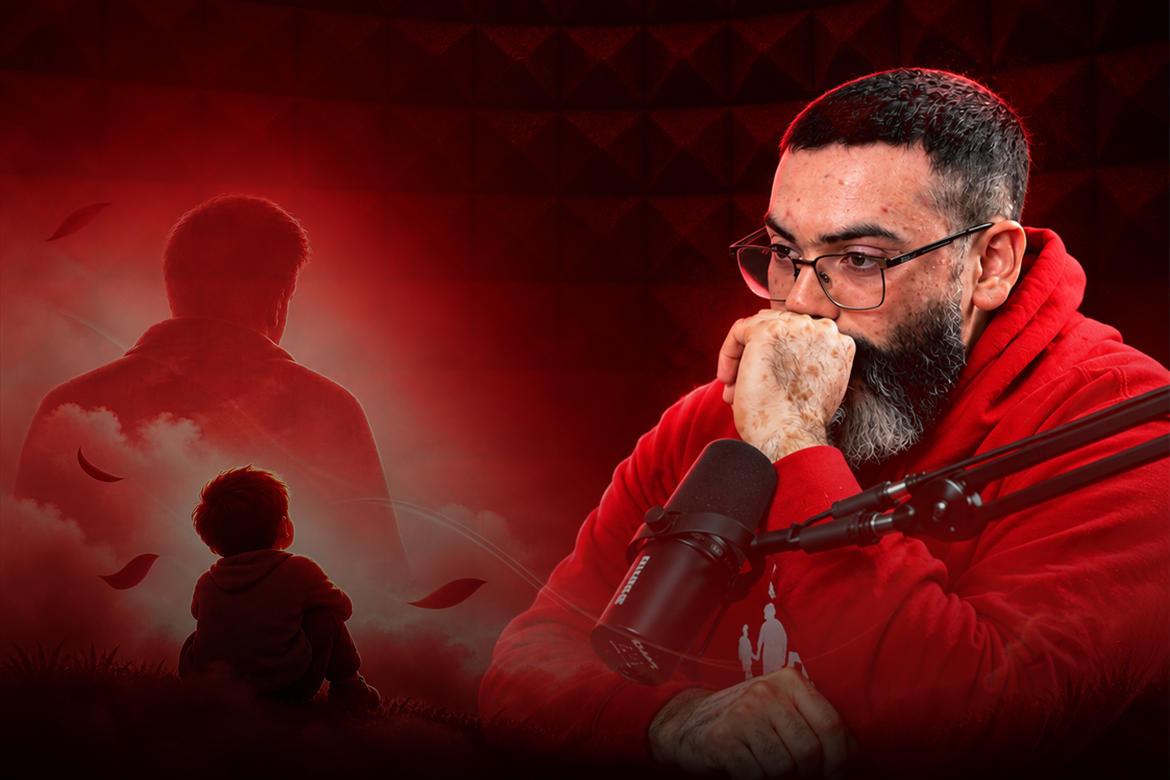

There is a particular kind of regret that arrives too late to fix. It shows up at a funeral, or a few months after one, when you reach for a story you half-remember your father telling and realise you never actually heard the whole thing. You don't know the name of the village. You don't know why he really left. You don't know what he was afraid of at twenty, or what made him laugh before you were born. The person who held those answers is gone, and the questions are now permanent.
Most fathers assume they have time. They assume the stories will always be there, sitting in their parents' heads, available whenever life slows down enough to ask. But life rarely slows down, and parents don't last forever. The single most important thing you can do this year more important than any DIY project, promotion, or fitness goal may simply be to sit your mother or father down and press record.
Why family stories matter more than you think
This isn't sentimentality. There's a body of research showing that a child's knowledge of their own family history is one of the strongest predictors of their emotional wellbeing.
The landmark work here comes from psychologists Marshall Duke and Robyn Fivush at Emory University. In the early 2000s they developed something called the "Do You Know?" scale a set of simple questions like Do you know where your grandparents grew up? Do you know how your parents met? Do you know of an illness or something really terrible that happened in your family? The children who could answer more of these questions turned out to have higher self-esteem, lower levels of anxiety, a stronger sense of control over their lives, and greater resilience in the face of setbacks.
The finding was popularised by writer Bruce Feiler in his 2013 New York Times essay "The Stories That Bind Us," and it has stuck around precisely because it's so counterintuitive. It isn't the family's wealth, or how often they went on holiday, or even how much time they spent together that mattered most. It was whether the children knew the narrative of where they came from.
Duke's explanation is that children who know their family story develop what he called a strong "intergenerational self." They understand that they belong to something bigger than themselves a line of people who struggled, survived, failed, recovered, and kept going. When their own life gets hard, they don't experience it as an isolated catastrophe. They experience it as one more chapter in a family that has always found a way through.
The story that heals is the one with the hard parts left in
Here's the detail that most people miss. The researchers found that the healthiest family narrative wasn't the triumphant one where everything always went well. Nor was it the defeated one where the family only ever suffered. It was what they called the oscillating narrative the honest one. "We built a good life here, but it wasn't easy. Your grandfather lost everything and started again. We had years that were very hard. And we came through them together."
That matters for how you record your parents' lives. Don't sanitise it. The ups and downs, the migrations, the losses, the mistakes and recoveries those are not the embarrassing bits to skip over. They are the load-bearing parts of the story. A child who grows up knowing their grandmother arrived in a new country with nothing and rebuilt from zero carries a quiet confidence that no motivational speech can install: the people I come from are people who survive.
Why fathers, especially, let this slip
If this is so valuable, why do so few of us actually do it? Part of the answer is that these conversations are genuinely hard to start and they seem to be particularly hard between men and their fathers.
Many of us grew up in homes where feelings weren't discussed and the past wasn't dwelt on. Our fathers were doers, not talkers. Asking "Dad, tell me what it was really like when you were young" can feel like breaking an unspoken rule, or like forcing an intimacy the relationship was never built for. So we wait for a natural opening that never quite comes, and then one day the opportunity is simply gone.
The uncomfortable truth is that "later" is not a plan. If you have a living parent or grandparent, the window is open right now, and you don't know how long it stays open.
How to actually do it, starting this week
You don't need a film crew or a book deal. You need a phone and a bit of intention.
Start small and low-pressure. You don't have to announce "I'm going to document your life." Just start asking one real question at the next visit, and let it breathe. A voice memo on your phone captures everything; you can worry about what to do with it later.
Ask open questions, not yes/no ones. "What's the earliest thing you remember?" "What was your father like?" "What's a decision you made that changed everything?" "What did you worry about at my age?" The "Do You Know?" questions themselves are a brilliant starting list.
Go for the hard chapters too. Ask about the losses, the risks, the moments they nearly gave up. That's where the resilience-building gold is.
Make it a ritual, not a one-off. A single interview will surface a few headlines. Regular, unhurried conversations surface the real texture the details that make your children feel they actually knew a person they may never meet.
Capture it in whatever form you'll actually use. Voice notes. Video on your phone. A shared document. A written book if you have the appetite for it. The medium matters far less than the fact that it exists.
What the Dadhood podcast adds
This idea came into sharp focus in a recent Dadhood conversation with debut novelist and father of three Munaf Dalvi, whose historical novel Daughter of Samarkand is steeped in the very idea of stories flowing across generations.
Munaf spoke with unusual honesty about his own regret. His father passed away in April of last year, and he admitted that for most of his life the two of them barely spoke about anything deep. "It was only towards the later times" that real conversations happened, he said. His grandfather had lived with the family too a man whose life spanned continents, who had left India and rebuilt in Kenya and Munaf, by his own admission, "never spoke to him at all" about any of it. Now, as a writer hungry for exactly those kinds of stories, he feels the loss keenly: there's so much there that I just don't know. His advice to younger fathers was direct make use of the time you have with your own parents now, and find out everything you can about their lives, because men in particular find this conversation difficult and keep putting it off.
What made the moment land was the host's response. He confessed to a goal he'd carried for years: to sit down with his mother who has lived a life full of dramatic ups and downs and write her story into a book. She's always been willing. He's simply never found the time. Hearing Munaf's regret, something shifted, and he said out loud what a lot of us need to hear: I think I need to actually do this. Munaf's reply was the whole article in three words: "Do it before it's too late."
That's the invitation. Not someday. Not when things calm down. Now, while the person who holds your family's stories is still in the room.
The takeaway: Your children's confidence is partly built from a story they can only get from you and that you can only get from your parents while they're still here. Pick one question. Press record this week. The stories that die with us didn't have to.
Written by
Mohammad Shoaib
Mohammad Shoaib is the founder of Dadhood a platform helping Muslim fathers grow into emotionally present, spiritually grounded leaders at home. Father of three. Community educator. Host of the Dadhood Podcast.